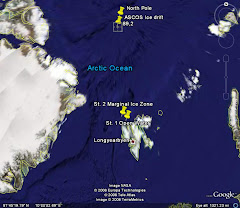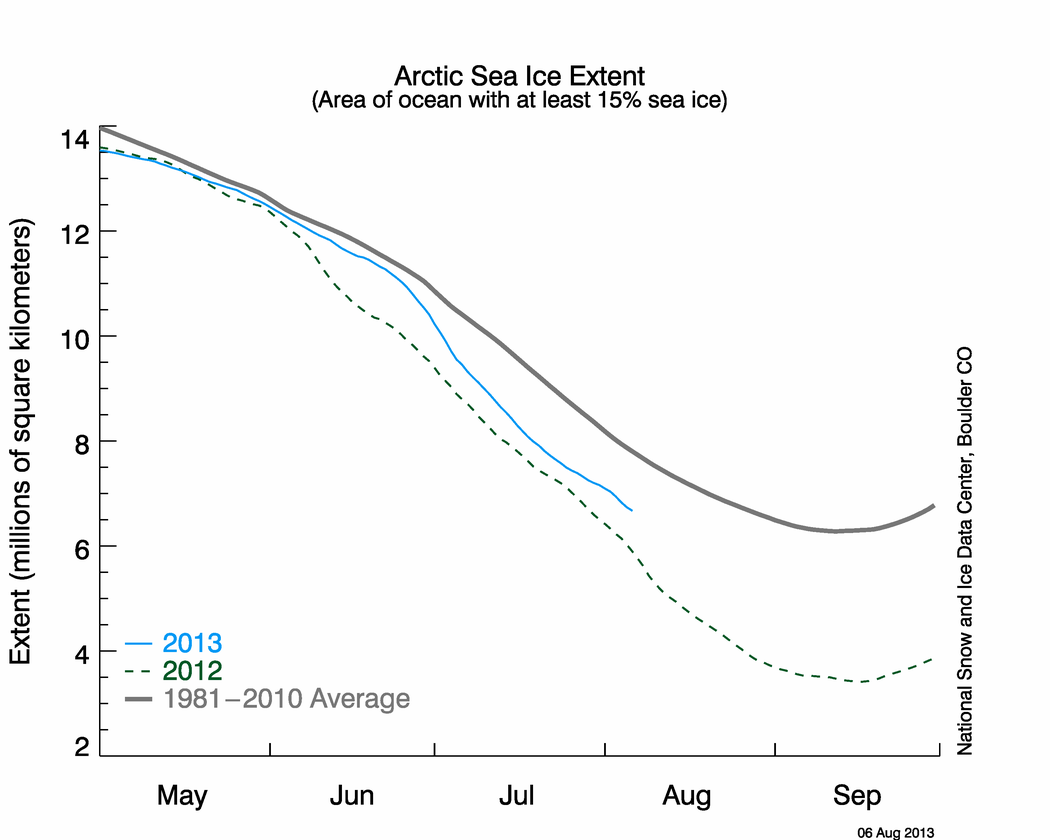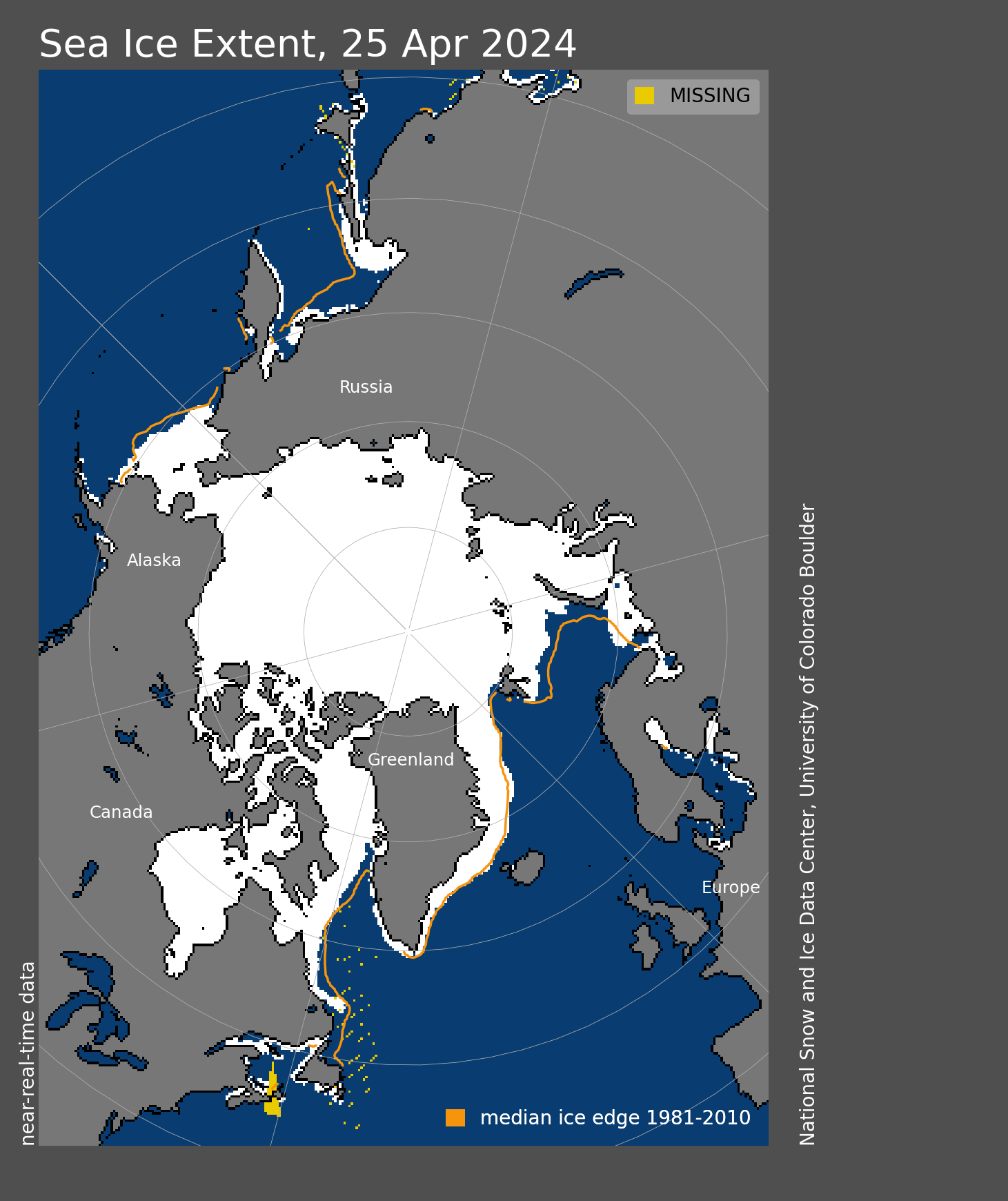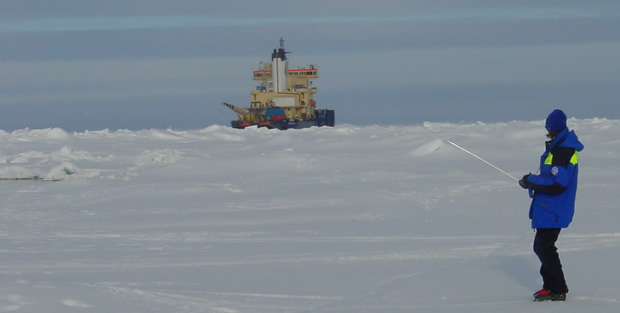
We are drifting south steadily; we went 3.5 nmiles today! We started at 87N o 17.3N, 09o 24.57W and woke up this Friday morning at 87o 14.95N 32.1W, a whooping 2.3 nmiles due S... Air temperatures are now consistently negative. We continue to be under high atmospheric pressure, with very low winds. We have just received the News item below, from the wire service... Up here at 87N, the surface seawater is starting to refreeze in a very spotty way and there is still plenty of open water; in our little corner of the ice, it is difficult to have a broader pan-Arctic perspective.
=======================================
Arctic Ice On The Verge Of Another All-Time Low
Envisat ASAR mosaic from mid-August 2008 showing an almost ice-free Northwest Passage. The direct route through the Northwest Passage is highlighted in the picture by an orange line. The orange dotted line shows the indirect route, called the Amundsen Northwest Passage, which has been passable for almost a month. Credits: ESA (= European Space Agency)
by Staff WritersParis, France (SPX) Aug 29, 2008Following last summer's record minimum ice cover in the Arctic, current observations from ESA's Envisat satellite suggest that the extent of polar sea-ice may again shrink to a level very close to that of last year.
Envisat observations from mid-August depict that a new record of low sea-ice coverage could be reached in a matter of weeks. The animation above is a series of mosaics of the Arctic Ocean created from images acquired between early June and mid-August 2008 from the Advanced Synthetic Aperture Radar (ASAR) instrument aboard Envisat.
The dark grey colour represents ice-free areas while blue represents areas covered with sea ice. Current ice coverage in the Arctic has already reached the second absolute minimum since observations from space began 30 years ago. Because the extent of ice cover is usually at its lowest about mid-September, this year's minimum could still fall to set another record low.
Each year, the Arctic Ocean experiences the formation and then melting of vast amounts of ice that floats on the sea surface. An area of ice the size of Europe melts away every summer reaching a minimum in September.
Since satellites began surveying the Arctic in 1978, there has been a regular decrease in the area covered by ice in summer - with ice cover shrinking to its lowest level on record and opening up the most direct route through the Northwest Passage in September 2007.
The direct route through the Northwest Passage - highlighted in the image above by an orange line - is currently almost free of ice, while the indirect route, called the Amundsen Northwest Passage, has been passable for almost a month. This is the second year in a row that the most direct route through the Northwest Passage has opened up.
Prof. Heinrich Miller from the Alfred Wegener Institute (AWI) in Bremerhaven, Germany commented that, "Our ice-breaking research vessel 'Polarstern' is currently on a scientific mission in the Arctic Ocean.
Departing from Iceland, the route has taken the ship through the Northwest Passage into the Canadian Basin where geophysical and geological studies will be carried out along profiles into the Makarov Basin to study the tectonic history and submarine geology of the central Arctic Ocean.
In addition, oceanographic as well as biological studies will be carried out. Polarstern will circumnavigate the whole Arctic Ocean and exit through the Northeast Passage."
Regarding the use of satellite data for polar research Miller continues, "The polar regions, especially the Arctic, are very sensitive indicators of climate change. The UN's Intergovernmental Panel on Climate Change has shown that these regions are highly vulnerable to rising temperatures and predicted that the Arctic would be virtually ice-free in the summer months by 2070.
Other scientists claim it could become ice-free as early as 2040. Latest satellite observations suggest that the Arctic could be mainly ice-free even earlier."
Miller added, "At AWI we place particular emphasis on studying Arctic sea-ice, and along with in-situ studies of sea-ice thickness change satellite data have been used extensively - not only for the regular observation of changes in the Arctic and Antarctic, but also for optimising the operation of Polarstern in regions covered by sea ice."
The Arctic is one of the most inaccessible regions on Earth, so obtaining measurements of sea ice was difficult before the advent of satellites. For more than 20 years, ESA has been providing satellite data for the study of the cryosphere and hence revolutionising our understanding of the polar regions.
Satellite measurements from radar instruments can acquire images through clouds and also at night. This capability is especially important in areas prone to long periods of bad weather and extended darkness - conditions frequently encountered in the polar regions.
By making available a comprehensive dataset from its Earth Observation satellites and other ground and air-based capabilities, ESA is currently also contributing to one of the most ambitious coordinated science programme ever undertaken in the Arctic and Antarctic - the International Polar Year 2007-2008.
Further exploitation of data collected over the Arctic since 1991 is part of an ESA Initiative on Climate Change that will be proposed to the ESA Member States at its Ministerial Conference in November 2008. The proposal aims to ensure delivery of appropriate information on climate variables derived from satellites.
In 2009, ESA will make another significant contribution research into the cryosphere with the launch of CryoSat-2. The observations made over the three-year lifetime of the mission will provide conclusive evidence on the rates at which ice thickness and cover is diminishing.
Friday, August 29, 2008

Thursday, August 28, 2008
Wednesday 27 August 2008
Every morning we get the following report from the aerosol lab prepared by Doug Orsini (U Leipzig), describing their observations for the previous day and the current meteorological conditions
===========================
Current conditions from the bridge:
Heading: 87.21
Wind True: 82 deg. Wind Speed: 3.1 m/s
Temp. : -3.1 C
There is a planned ship engine test today at 14:30. (This means shut down your atmospheric sampling or you'll sample black ship exhaust)
Tuesday Aug 26, between 12:00 and 16:00 we measured a rather fluctuating but semi-continuous period of nucleation (= formation if tiny new particles). This was the day that the ship sat to the Northwest of a band of sunshine. We are now dominated by a high pressure system, and winds should slowly rotate from the North as it moves through.
Current trajectories (= where the air is coming from and where it has been for the previous days as it affects its chemical and physical properties) show an air history that has been at least 3 days over the pack ice. Air is drier (90% relative humidity), stable (= it is has been thoroughly mixed top to bottom), and coming around the pole from the east.
Helicopter Flights:
Staffan:
"Yesterday at noon, an event (= particle formation) of diameters 3-10nm was detected, confined from ground to 100 meters height (in the air) below the (atmospheric) inversion. We flew at 18:00 out Southeast to the sunny stripe and there was a similar event. At 23:30, that event had faded and cold air moved in under the cloud layer from the east. "
Gas Results:
A perfect sampling mission at 23:30 showed that in the (atmospheric) inversion, elevated levels of DMS were detected,-a factor of 10 higher than the very low levels at the surface. That was also detected at the cloud edge, out in the sun.
===========================
Current conditions from the bridge:
Heading: 87.21
Wind True: 82 deg. Wind Speed: 3.1 m/s
Temp. : -3.1 C
There is a planned ship engine test today at 14:30. (This means shut down your atmospheric sampling or you'll sample black ship exhaust)
Tuesday Aug 26, between 12:00 and 16:00 we measured a rather fluctuating but semi-continuous period of nucleation (= formation if tiny new particles). This was the day that the ship sat to the Northwest of a band of sunshine. We are now dominated by a high pressure system, and winds should slowly rotate from the North as it moves through.
Current trajectories (= where the air is coming from and where it has been for the previous days as it affects its chemical and physical properties) show an air history that has been at least 3 days over the pack ice. Air is drier (90% relative humidity), stable (= it is has been thoroughly mixed top to bottom), and coming around the pole from the east.
Helicopter Flights:
Staffan:
"Yesterday at noon, an event (= particle formation) of diameters 3-10nm was detected, confined from ground to 100 meters height (in the air) below the (atmospheric) inversion. We flew at 18:00 out Southeast to the sunny stripe and there was a similar event. At 23:30, that event had faded and cold air moved in under the cloud layer from the east. "
Gas Results:
A perfect sampling mission at 23:30 showed that in the (atmospheric) inversion, elevated levels of DMS were detected,-a factor of 10 higher than the very low levels at the surface. That was also detected at the cloud edge, out in the sun.
Tuesday, August 26, 2008
Tuesday 26 August 2008
At 87o 21.20N 07o 41.98W, -2C, winds <4m/s, good visibility, high stratocumulus clouds above us and northwards but clear skies and sun rays can be seen all day in the southward horizon.
Ice-bear story (by Sara de la Rosa):
Six days have passed since the polar bear gave us a curious visit...I guess I've been waiting for his next appearance to happen before I write this story! But so far he's been keeping well away from us.
It was just 6am as Thorsten and I were heading towards the ship from our oceanography ice-tent located some 100 m away from the ship. I was 10 steps from the gangway when I suddenly saw these big eyes staring at me...
The first milliseconds I was just paralized, trying to figure out whether what I saw was some fake bear set up on the ice by the crew as a joke, or whether it was actually a real one! As he slowly turned his head back to watch the seal hole where he was standing by, I realized that it was a real bear. The Arctic experience that I was hoping for!
I had no radio on me, so I tried best I could to get some words out my mouth to tell Thorsten to radio the bridge and warn them of the polar bear's presence. From the ice, the bear first seemed just 50m away from us, but as we got back onto the ship we saw that he was more like 180m away. He seemed a young male bear, but showed absolutely no interest on the icebreaker nor us (9 people awake at the time), watching him for about 40 minutes. It took him a long while to react to the ship's horn that blew to try to scare him off...all he probably wanted was to relax by the seal hole and us to leave him alone! Eventually as the bear retreated, the helicopter took off and scared him even further away from our ice-flow.
The reason that nobody had seen the bear arrive close to the ship the night before was because a dense fog-band was blocking the view from the bear-watchers on the bridge. The bear cleverly kept well out from the visibility line as he walked passed our ice camps.- Therefore, all precautions on the ice have been increased, such that some of us working on the ice have had to miss many working hours. Due to the presence of fog around us we had to stay onboard until visibility cleared up. Weather and visibility have now stayed considerably clear for some days, making both work on the ice and bear-watchers happy.
Ice-bear story (by Sara de la Rosa):
Six days have passed since the polar bear gave us a curious visit...I guess I've been waiting for his next appearance to happen before I write this story! But so far he's been keeping well away from us.
It was just 6am as Thorsten and I were heading towards the ship from our oceanography ice-tent located some 100 m away from the ship. I was 10 steps from the gangway when I suddenly saw these big eyes staring at me...
The first milliseconds I was just paralized, trying to figure out whether what I saw was some fake bear set up on the ice by the crew as a joke, or whether it was actually a real one! As he slowly turned his head back to watch the seal hole where he was standing by, I realized that it was a real bear. The Arctic experience that I was hoping for!
I had no radio on me, so I tried best I could to get some words out my mouth to tell Thorsten to radio the bridge and warn them of the polar bear's presence. From the ice, the bear first seemed just 50m away from us, but as we got back onto the ship we saw that he was more like 180m away. He seemed a young male bear, but showed absolutely no interest on the icebreaker nor us (9 people awake at the time), watching him for about 40 minutes. It took him a long while to react to the ship's horn that blew to try to scare him off...all he probably wanted was to relax by the seal hole and us to leave him alone! Eventually as the bear retreated, the helicopter took off and scared him even further away from our ice-flow.
The reason that nobody had seen the bear arrive close to the ship the night before was because a dense fog-band was blocking the view from the bear-watchers on the bridge. The bear cleverly kept well out from the visibility line as he walked passed our ice camps.- Therefore, all precautions on the ice have been increased, such that some of us working on the ice have had to miss many working hours. Due to the presence of fog around us we had to stay onboard until visibility cleared up. Weather and visibility have now stayed considerably clear for some days, making both work on the ice and bear-watchers happy.
Monday 25 August 2008
At 87o 21.69N, 07o 28.73W, warmer at -1.7C, low winds. Low winds imply that the winds are not coming from a consistent and constant direction; this is not good for the atmospheric particles (=aerosol) and gases that are being sampled continuously on the 4th and 7th decks of Oden, as the exhaust from the single ship engine can be pulled in to the samples, sometimes destroying them. So Oden was turned to face into the wind this morning. Indeed, many of the variables measured in aerosols are in very low concentrations so they require a long sampling of 24h. If they become dirty towards the end of their sampling period, the sample is unusable, despite the effort. They have had a watch system with a scientist watching the pollution monitor around a clock. Sunday and Monday were very exciting for them as they had major events of new atmospheric particle formation (= nucleation events). These very tiny particles grow (= increase in size) to form cloud condensation nuclei (CCN) that provide the "seeds" that form the tiny cloud droplets that will lead to the formation of clouds and fog. The composition, appearance and number of cloud droplets and associated CCN affect the formation of clouds and how long they last. If the number of CCN increases, more, but smaller, cloud droplets will form. This will result in whiter, longer-lasting clouds that reflect more incoming sunlight back into space and allow less solar energy (= heat and light) to reach the sea and the ice surfaces here in the Arctic Ocean. So there is an effect on the biology in seawater and the melting/freezing of seawater and sea ice.
Despite the effort of our dedicated swimmers, the lead froze yesterday evening and we were not able to sample microlayer. This morning the helicopter pilot flew to the lead and created enough wind to crack the ice in a couple of places. We rushed to sample with the small microlayer boat and collected 300 ml of sample (not very much) before the lead started to freeze over again.
At 1900 GMT, Maine Public Broadcasting Network (Maine's National Public Radio station) called Oden to do an interview. It can be heard at
http://www.mpbn.net/radio/mainenews/080825acrtic.htm <http://mail.polar/exchweb/bin/redir.asp?URL=http://www.mpbn.net/radio/mainenews/080825acrtic.htm>
We told the journalist that there are 64 people on board= 21 from Oden + 10 from Swedish Polar Research Secretariat logistics (including 2 heli pilots, 2 bear guards, and the physician) + 31 scientists. We have 12 nationalities on board. We work 24h/ day, 7 days per week but also manage to have a social life with some people participating in one or more or none of these activities: karate class, ping pong tournament, cinema club, lecture series and we all celebrate birthdays.
We communicate with our friends, family and colleagues by Iridium email and phone.
We've had a high security level due to the polar bear "highway" we seem to be in but every one (crew, polar and scientists) are pitching in to provide bear guarding so those of us on the ice can do our work. Thank you!
In our lead group, an informal survey indicates that we miss Mexican food, fresh fruit, family and dogs, not necessarily in that order J
A small, unofficial survey indicates that we have been surprised by the small amount of life we can see which makes the surroundings a bit intimidating but the 3 polar bears and 4 seals are more than we expected and keep things exciting. Seeing a lot of ice algae is not as moving for most while Monica and Paty get very excited by their mucus. Those of us who have been here before are surprised by the earlier than expected freeze up and by the swimming activities of the captain and staff captain.
To the scout patrol in Santiago, Chile who sent the following questions, here you go. Send more questions! Thank you!
-¿que tienen que ver las microalgas en todos esto?
Las microalgas, ya sea que esten flotando en el fitoplancton o inmoviles en el hielo, fotosintetizan todo el tiempo mientras haya luz, igual que las plantas terrestres, creando material organica. Como estan en el agua, lo que sueltan queda disuelto en el agua que las rodea (asi como las plantas "sueltan" su perfume al aire que las rodea). Este material organico disuelto (incluyendo gases, particulas y sales) se junta en la superficie del agua, en la interface entre agua y aire (= capa superficial o "surface microlayer") donde esta ahora disponible para ser introducido a la atmosfera por el viento o burbujas.
-¿que tienen las microalgas que de origen al nucleo de las nubes?
Las microalgas producen un gas llamado dimetil sulfuro (DMS) que cuando es introducido en el aire es foto-oxidado por la luz solar a otros compuestos derivados, los cuales forman nucleos de condensacion. Ademas, las microalgas forman material organica disuelta la cual tambien forma microgeles (= "moco" microscopico, si, parecido al moco de la nariz J). Estas microgeles han sido observadas en el agua y en los aerosoles. Esta expedicion esta basada en la hipotesis que estas microgeles tambien actuan como nucleos de condensacion en el aire y, ademas, a veces proveen una superficie para la condensacion de los productos de la oxidacion del DMS.
-¿que les faltan a las algas para producir el nucleo ?
No esta claro. Se piensa que las microalgas producen DMS y el compuesto precursor DMSP (dimetil sulfuro propionato) en agues constantemente frias porque 1) hace frio, como un protector criogenico del material celular; 2) como un agente antibacteriano y an-predador; 3) cuando estan felices y creciendo activamente, como una via metabolica para eliminar energia en exceso (a traves de la formacion y eliminacion de aminoacidos y proteinas que contienen azufre); 4) como respuesta metabolica a un stress externo ambiental (demasiada radiacion ultravioleta, falta de nutrients, mucha luz y falta de luz)
-¿como podriamos ayudar desde aca?
Uds. pueden ayudar reduciendo la cantidad de particulas introducidas en el aire, ya sea quemando menos basura, calentado las casas con metodos que reducen las particulas en el aire, quemando eficientemente, ensenando a otros ninos y en el colegio lo importante que es reciclar, promoviendo la reduccion del smog. Reducir la cantidad de particulas en el aire es muy bueno para la salud y es muy importante para el ambiente.
Despite the effort of our dedicated swimmers, the lead froze yesterday evening and we were not able to sample microlayer. This morning the helicopter pilot flew to the lead and created enough wind to crack the ice in a couple of places. We rushed to sample with the small microlayer boat and collected 300 ml of sample (not very much) before the lead started to freeze over again.
At 1900 GMT, Maine Public Broadcasting Network (Maine's National Public Radio station) called Oden to do an interview. It can be heard at
http://www.mpbn.net/radio/mainenews/080825acrtic.htm <http://mail.polar/exchweb/bin/redir.asp?URL=http://www.mpbn.net/radio/mainenews/080825acrtic.htm>
We told the journalist that there are 64 people on board= 21 from Oden + 10 from Swedish Polar Research Secretariat logistics (including 2 heli pilots, 2 bear guards, and the physician) + 31 scientists. We have 12 nationalities on board. We work 24h/ day, 7 days per week but also manage to have a social life with some people participating in one or more or none of these activities: karate class, ping pong tournament, cinema club, lecture series and we all celebrate birthdays.
We communicate with our friends, family and colleagues by Iridium email and phone.
We've had a high security level due to the polar bear "highway" we seem to be in but every one (crew, polar and scientists) are pitching in to provide bear guarding so those of us on the ice can do our work. Thank you!
In our lead group, an informal survey indicates that we miss Mexican food, fresh fruit, family and dogs, not necessarily in that order J
A small, unofficial survey indicates that we have been surprised by the small amount of life we can see which makes the surroundings a bit intimidating but the 3 polar bears and 4 seals are more than we expected and keep things exciting. Seeing a lot of ice algae is not as moving for most while Monica and Paty get very excited by their mucus. Those of us who have been here before are surprised by the earlier than expected freeze up and by the swimming activities of the captain and staff captain.
To the scout patrol in Santiago, Chile who sent the following questions, here you go. Send more questions! Thank you!
-¿que tienen que ver las microalgas en todos esto?
Las microalgas, ya sea que esten flotando en el fitoplancton o inmoviles en el hielo, fotosintetizan todo el tiempo mientras haya luz, igual que las plantas terrestres, creando material organica. Como estan en el agua, lo que sueltan queda disuelto en el agua que las rodea (asi como las plantas "sueltan" su perfume al aire que las rodea). Este material organico disuelto (incluyendo gases, particulas y sales) se junta en la superficie del agua, en la interface entre agua y aire (= capa superficial o "surface microlayer") donde esta ahora disponible para ser introducido a la atmosfera por el viento o burbujas.
-¿que tienen las microalgas que de origen al nucleo de las nubes?
Las microalgas producen un gas llamado dimetil sulfuro (DMS) que cuando es introducido en el aire es foto-oxidado por la luz solar a otros compuestos derivados, los cuales forman nucleos de condensacion. Ademas, las microalgas forman material organica disuelta la cual tambien forma microgeles (= "moco" microscopico, si, parecido al moco de la nariz J). Estas microgeles han sido observadas en el agua y en los aerosoles. Esta expedicion esta basada en la hipotesis que estas microgeles tambien actuan como nucleos de condensacion en el aire y, ademas, a veces proveen una superficie para la condensacion de los productos de la oxidacion del DMS.
-¿que les faltan a las algas para producir el nucleo ?
No esta claro. Se piensa que las microalgas producen DMS y el compuesto precursor DMSP (dimetil sulfuro propionato) en agues constantemente frias porque 1) hace frio, como un protector criogenico del material celular; 2) como un agente antibacteriano y an-predador; 3) cuando estan felices y creciendo activamente, como una via metabolica para eliminar energia en exceso (a traves de la formacion y eliminacion de aminoacidos y proteinas que contienen azufre); 4) como respuesta metabolica a un stress externo ambiental (demasiada radiacion ultravioleta, falta de nutrients, mucha luz y falta de luz)
-¿como podriamos ayudar desde aca?
Uds. pueden ayudar reduciendo la cantidad de particulas introducidas en el aire, ya sea quemando menos basura, calentado las casas con metodos que reducen las particulas en el aire, quemando eficientemente, ensenando a otros ninos y en el colegio lo importante que es reciclar, promoviendo la reduccion del smog. Reducir la cantidad de particulas en el aire es muy bueno para la salud y es muy importante para el ambiente.
Monday, August 25, 2008
August 23 & 24, 2008
At 22:10 GMT on Sunday, we are at 87o 25.02N, 07o 22.43W. Saturday's weather was warmer, almost -0.5C and very calm which translated into fog, fog, fog. The physical oceanography camp consisted of a large canvas tent that held inside an ice hole with instruments deployed down to the water, a winch and multiple computers; yesterday, the tent was replaced by a cubic, hard-shell hut (similar to the one we have at the lead) for bear security reasons. At one point, there were 13 people assembling the hut in order to do it as fast as possible. There still is too much ice to sample seawater at the lead. Now we need stronger winds and of a different direction to dislodge and/or break the ice! Mmm, some days there is too much wind, others not enough...
A plan was conceived Saturday night by one of Oden's oilers, Per Blad, to go swimming and thus break the ice at the lead. And it was implemented on Sunday morning! Oden's Captain and Staff Captain wore orange immersion suits and went into the water, while tied at the waist. Thank you!! The orange suits keep the wearer mostly dry and warm; most oceanographers have to try them on at least once in each cruise but few get to actually wear them in the water, even as training. Hopefully, no one needs to wear it! The ice beaking will facilitate sampling the surface microlayer with our remote controlled boats; Carlton and Johan are at the lead right now sampling. Keep your fingers crossed!
While the ice breaking was going on, Andy and Carlton drilled an ice core, about 3m long. They sliced into 10 cm sections which were brought to the lab where we are slowly melting them in the refrigerator. We will sample them in a few days when they have melted.
A plan was conceived Saturday night by one of Oden's oilers, Per Blad, to go swimming and thus break the ice at the lead. And it was implemented on Sunday morning! Oden's Captain and Staff Captain wore orange immersion suits and went into the water, while tied at the waist. Thank you!! The orange suits keep the wearer mostly dry and warm; most oceanographers have to try them on at least once in each cruise but few get to actually wear them in the water, even as training. Hopefully, no one needs to wear it! The ice beaking will facilitate sampling the surface microlayer with our remote controlled boats; Carlton and Johan are at the lead right now sampling. Keep your fingers crossed!
While the ice breaking was going on, Andy and Carlton drilled an ice core, about 3m long. They sliced into 10 cm sections which were brought to the lab where we are slowly melting them in the refrigerator. We will sample them in a few days when they have melted.
Saturday, August 23, 2008
Friday 8/22/2008
87o 22.25N 07o 21.48.0W; air temperature -7.5C; winds 4-5 m/s; drifting south at 0.1 knots
Still cold at -7.6C and the lead is frozen over. The Canadian OOTI instrument continues sampling over the lead and the report of some frost flowers seen on the newly formed ice should make its owner Dr. Jan Bottenheim (Environment Canada) very happy. All other sensors are covered with ice. All the ship railings and ropes are also covered with hoar frost crystals.
We have used the morning to catch up with sample analyses, data entry, writing these blogs, finishing experiments, and designing and setting up new experiments. The fog comes and goes, controlling the length of time the researchers working at the meteorological and oceanography camps can safely spend outdoors. Pea soup thick fog rolls in and out, such that the observers on the bridge do not have good visibility and the researchers are called in and have to wait, sometimes for many hours, until it is safe for them to go out again.
Still cold at -7.6C and the lead is frozen over. The Canadian OOTI instrument continues sampling over the lead and the report of some frost flowers seen on the newly formed ice should make its owner Dr. Jan Bottenheim (Environment Canada) very happy. All other sensors are covered with ice. All the ship railings and ropes are also covered with hoar frost crystals.
We have used the morning to catch up with sample analyses, data entry, writing these blogs, finishing experiments, and designing and setting up new experiments. The fog comes and goes, controlling the length of time the researchers working at the meteorological and oceanography camps can safely spend outdoors. Pea soup thick fog rolls in and out, such that the observers on the bridge do not have good visibility and the researchers are called in and have to wait, sometimes for many hours, until it is safe for them to go out again.
Thursday 8/21/2008
By 16:00, we are at 87o 22.18N 07o 05.25.0W; air temperature -7.6C (=18.3F); winds <3 m/s; drifting south at 0.1 knots. The sun is still out!! And it is cold, very cold. These conditions of sunny, cold, little fog and high cirrus clouds has shown in the past to be ideal for nucleation events, that is, the formation of the smallest particles that the aerosol instruments can detect (<20 nm, that 10^-9m). And they've seen lots all through the night. These small particles were also seen by the instruments flown by the helicopter. On the other hand, instruments located in the very cold outside are slowing down, computer hard drives are refusing to work properly, and all 3 bubble-related devices are frozen in; the lead has now a 1cm layer of ice over the water.
Monica and Paty want to understand what happens to this organic material in the surface microlayer when it is exposed to light, especially ultraviolet radiation, for 24h per day, as it happens in spring and summer. So we prepared a wooden raft from which we hung our samples in small special bags; we covered one half of the raft with a clear film that blocks all UV radiation and the other side was exposed to natural light. We placed in open water next to the ship and tied it to the ice, just 2m away from the ship. This sounds simple; however, at -7.6C, we both had outer clothing, a life jacket, a radio and a bear guard. I radio the ship's bridge ("command center") for permission to go onto the ice and deploy; depending on what else it is going on, it is granted or we wait until it is OK; down we go. I tie a special belt around my waist which is tied to a rope held by the bear guard (either Lars-Åke Hansson, the ship's bosun or Fredrik Flink, our bear guard); I lay over the edge of the ice so I can get my hands inside the float and either hang or retrieve my baggies; I wear diving gloves; the water is very cold (-1.75C). We are done in 5 minutes. We pick up our samples, return on board Oden, radio the bridge to let them know we're back, return the radio, undress and run to the lab to process our samples.
By late evening, with temperatures staying at -7.6C, the lead is frozen with a 3cm-thick layer of ice and any liquid sampling is difficult as both seawater and chemicals freeze as soon as they are exposed to air.
Monica and Paty want to understand what happens to this organic material in the surface microlayer when it is exposed to light, especially ultraviolet radiation, for 24h per day, as it happens in spring and summer. So we prepared a wooden raft from which we hung our samples in small special bags; we covered one half of the raft with a clear film that blocks all UV radiation and the other side was exposed to natural light. We placed in open water next to the ship and tied it to the ice, just 2m away from the ship. This sounds simple; however, at -7.6C, we both had outer clothing, a life jacket, a radio and a bear guard. I radio the ship's bridge ("command center") for permission to go onto the ice and deploy; depending on what else it is going on, it is granted or we wait until it is OK; down we go. I tie a special belt around my waist which is tied to a rope held by the bear guard (either Lars-Åke Hansson, the ship's bosun or Fredrik Flink, our bear guard); I lay over the edge of the ice so I can get my hands inside the float and either hang or retrieve my baggies; I wear diving gloves; the water is very cold (-1.75C). We are done in 5 minutes. We pick up our samples, return on board Oden, radio the bridge to let them know we're back, return the radio, undress and run to the lab to process our samples.
By late evening, with temperatures staying at -7.6C, the lead is frozen with a 3cm-thick layer of ice and any liquid sampling is difficult as both seawater and chemicals freeze as soon as they are exposed to air.
Subscribe to:
Posts (Atom)