This morning at 0615, we were visited by a polar bear seen sleeping about 50m behind the ship. Sara de la Rosa Hohn, who spotted, it will tell us the story. This delayed ALL activities on ice for the morning.
By 12:00, we are at 87o 25.15N 08o 09.04.0W; air temperature -0.6C; winds 4.5-7 m/s; drifting south at 0.1 knots. BUT, the sun came out!! We can see blue sky and shadows for the first time in days! The snow has acquired shades of blue and the open water of the lead glows like a jewel. The lead is open to its widest extension today, almost 1 km wide. Monica went to the lead today; it was her first chance to see the field operations there.
One of the big science questions we have is how does the organic material present in the surface microlayer and subsurface water make it into the air? In open sea water, the wind stirs up the surface, waves form and break, spray and bubbles are generated. Here in the pack ice, if it gets windier then the open leads simply close for the most part, with very little spray visible. Are there bubbles in the water? If so, what size, how many, how frequent? ASCOS has deployed a bubble camera at the lead (G de Leeuw- Finnish Meteorological Institute, operated by Sarah Norris- U Leeds and Andy Hind- Bigelow) to capture images of bubbles rising to the surface. There are bubbles!! The next step is to capture organic material that is available to be "sprayed" into the air. To this effect we have 2 floating systems, the "Bubble Buoy" and the "Bubble Cat", that are simulating the spray by using an air pump that "bubbles" the water and the spray is then collected onto different types of filters for chemical and microscope analyses. Monica spent her time at the lead conducting such experiments, as well as driving the remote controlled surface microlayer boat samplers.
Two seals have visited the lead; today both followed the small remote controlled microlayer sampling boat and the operators had fun following the seals with the boat while slowly sampling. One of the seals would stick out the neck and even more of its body out of the water to see what was going on.
Then, we had a helicopter rescue! The battery on the small microlayer sampler ran out and/or the boat was too far away for an effective control by the operator such that the engine no longer responded; the wind pushed it and it got tangled in the ice. Johan sailed the large sampling boat to the rescue but it got tangled on loose ice on the other side of the lead and now we had 2 lost boats! The helicopter picked up Johan and flew him to the other side of the lead. The small boat was picked up by hand and placed inside the heli. The large boat was tied to a rope and carefully lifted by the heli over the lead and into the ice while Johan waited. Then all people and boats were re-united on the camp side.
Saturday, August 23, 2008

Tuesday 8/19/2008
87o 28.58N 09o 21.0W; air temperature -0.7C; low winds <2m/s; drifting south at 0.1 knots, cloudy, foggy (what's new about this! Welcome to Arctic Ocean summer weather!)
The seawater and the under side of the sea ice is today filled with clumps and strings of the ice diatom Melosira arctica which look a healthy greenish brown and beautiful under the microscope. Diatoms are pill-box shaped, with the cell located inside the silica (= glass)-made box, with the boxes attached to each other forming long chains. In this case, the chains of cells also have a covering of mucus. This mucus may be what is clogging our filters today.
While Monica and Paty have been doing experiments in the lab on board Oden, Carlton, Gao, Andreas, and Fred have gone to sample the lead. The lead group usually stays out for 4h, with another hour used in transportation to and from the lead and Oden. Andy and Carlton are now driving the snow mobiles. While this is not new for Mainer Carlton, it is a first for Andy; it is the first time in the Arctic Ocean, this close to the North Pole. This is to the great envy of other cruise participants who feel "stuck" inside the ship. One of the main activities at the lead is the exchange of 12V car batteries that provide power for the 2 systems that run continuously (the Canadian OOTI for atmospheric ozone and bromine oxide and a flux system as well as the 3 systems dedicated to bubble images and bubbling flux experiments. We move approximately 13 batteries by snowmobile every day; they are charged on board the ship around the clock.
The seawater and the under side of the sea ice is today filled with clumps and strings of the ice diatom Melosira arctica which look a healthy greenish brown and beautiful under the microscope. Diatoms are pill-box shaped, with the cell located inside the silica (= glass)-made box, with the boxes attached to each other forming long chains. In this case, the chains of cells also have a covering of mucus. This mucus may be what is clogging our filters today.
While Monica and Paty have been doing experiments in the lab on board Oden, Carlton, Gao, Andreas, and Fred have gone to sample the lead. The lead group usually stays out for 4h, with another hour used in transportation to and from the lead and Oden. Andy and Carlton are now driving the snow mobiles. While this is not new for Mainer Carlton, it is a first for Andy; it is the first time in the Arctic Ocean, this close to the North Pole. This is to the great envy of other cruise participants who feel "stuck" inside the ship. One of the main activities at the lead is the exchange of 12V car batteries that provide power for the 2 systems that run continuously (the Canadian OOTI for atmospheric ozone and bromine oxide and a flux system as well as the 3 systems dedicated to bubble images and bubbling flux experiments. We move approximately 13 batteries by snowmobile every day; they are charged on board the ship around the clock.
Saturday 16 to Monday 18 August 2008 2400 GMT
It's been busy, busy. Our position each of these mornings has been 87o 29.6N, 06o 31.83W; then 87o 29.73N, 08o 19.11W; this morning 87o 29.74N, 09o 15.57W; and right now 87o 34.6N, 09o 23.17W... we have drifting westward for the last 3 days!
Winds have calmed down to no wind; this is good for us as the boats operate best under light winds and for the meteorologists who are flying a giant red balloon to sample cloud air. No wind is not good for the atmospheric chemists who depend on some wind of a fixed direction to always be sampling upwind, thus avoiding getting any pollution from the ship in their samples. This lack of wind forced turning the ship around so as to have the bow facing into the wind. This is the 2nd time the ship is loosened from the ice, the engines turned on, the ship turned around and re-tied to the ice: on one side we can use the gangway but on the other we get on and off the ship using a ladder on the side of Oden. Back to the red balloon: it is attached to a very strong line that is spooled into a small winch that allows raising and lowering the balloon. Meteorological and aerosol sensors are hanging from the ballon that can then be taken up to 1 km up in the air and sample clouds. Tonight we hung a very clean piece of rope from the balloon to collect some cloud water; it should freeze as the balloon is released up and up; then the rope will go into a clean bag. Now we have to figure out how to actually sample this water; maybe we'll centrifuge the rope!
The rope did not work as it was too thick, with too many places for the water to hide in. A flat string would be better. So Monica has donated the shoe laces from her running shoes for this; we have washed them with 10% HCl and then with distilled water. They are now the cleanest shoe laces you've ever seen.
Winds have calmed down to no wind; this is good for us as the boats operate best under light winds and for the meteorologists who are flying a giant red balloon to sample cloud air. No wind is not good for the atmospheric chemists who depend on some wind of a fixed direction to always be sampling upwind, thus avoiding getting any pollution from the ship in their samples. This lack of wind forced turning the ship around so as to have the bow facing into the wind. This is the 2nd time the ship is loosened from the ice, the engines turned on, the ship turned around and re-tied to the ice: on one side we can use the gangway but on the other we get on and off the ship using a ladder on the side of Oden. Back to the red balloon: it is attached to a very strong line that is spooled into a small winch that allows raising and lowering the balloon. Meteorological and aerosol sensors are hanging from the ballon that can then be taken up to 1 km up in the air and sample clouds. Tonight we hung a very clean piece of rope from the balloon to collect some cloud water; it should freeze as the balloon is released up and up; then the rope will go into a clean bag. Now we have to figure out how to actually sample this water; maybe we'll centrifuge the rope!
The rope did not work as it was too thick, with too many places for the water to hide in. A flat string would be better. So Monica has donated the shoe laces from her running shoes for this; we have washed them with 10% HCl and then with distilled water. They are now the cleanest shoe laces you've ever seen.
Saturday, August 16, 2008
Friday 15 August 2008, 2300 GMT
We are at 87o 28.62N 06o 05.97W. It is very foggy, enough that all evening sampling on ice was cancelled. We were on our way to the lead to set up OOTI, a sled with sensors designed to measure atmospheric concentrations of ozone and bromine oxide sent by Dr. Jan Bottenheim (Environment Canada) and operated on board by Rachel Chang (U Toronto), when the group was told to return to Oden. OOTI's first day shall be tomorrow. Safety and polar bears (see the picture of the bear at the lead taken by Sven Lidstrom) are very prominent in every body's mind.
There also is an aircraft component to this project: the NASA DC-8 flew over us twice this morning. It is flying all the way from northern Sweden; it is a 10h flight here and back. Research on the aircraft focuses on radiation and clouds (Dr. Ola Persson, U Colorado) and aerosols (Dr. Barbara Brooks, U Leeds). Plus, we have our own helicopter on Oden for both atmospheric science missions and logistical efforts (transport of people and equipment, bear scaring, ice reconnaissance).
Our focus is to understand how clouds are formed in the high Arctic Ocean in the summer. Aerosols (that is particles in the air) contain organic material which we believe result from biological activity in the surface seawater. We will be measuring this biological activity in several ways both in the skin (=surface microlayer) between the air and the water as well as in the water just below this skin (= subsurface water). Phytoplankton and ice algae are the primary producers of this organic material and we've collected them in our filters and observed them under the microscope here.
There also is an aircraft component to this project: the NASA DC-8 flew over us twice this morning. It is flying all the way from northern Sweden; it is a 10h flight here and back. Research on the aircraft focuses on radiation and clouds (Dr. Ola Persson, U Colorado) and aerosols (Dr. Barbara Brooks, U Leeds). Plus, we have our own helicopter on Oden for both atmospheric science missions and logistical efforts (transport of people and equipment, bear scaring, ice reconnaissance).
Our focus is to understand how clouds are formed in the high Arctic Ocean in the summer. Aerosols (that is particles in the air) contain organic material which we believe result from biological activity in the surface seawater. We will be measuring this biological activity in several ways both in the skin (=surface microlayer) between the air and the water as well as in the water just below this skin (= subsurface water). Phytoplankton and ice algae are the primary producers of this organic material and we've collected them in our filters and observed them under the microscope here.
Thursday 14 August 2008
We are at 87o 19.4N 003o 51.04W, The air temperature is -2.0C, foggy, and winds of 9-10 m/s. As the ice floe drifts southwards, on average, it spins and sometimes actually heads towards the north for a large part of the day. The combination of wind, spin and drift filled our sampling site at the lead with ice and we could not deploy our remote controlled boats that sample the very surface layer of seawater. We assembled and tested them in the hut by the lead's "open" water. We spent 4h out, with lunch brought from the ship (sandwiches, dry soup and hot chocolate envelopes, several thermos with hot water, and cookies). Andy is still trying to fix and re-soder the data cable for the underwater light meter and a diagram received today from the manufacturer will be very helpful. A picture taken from the helicopter shows our lead!
Wednesday 13 August 2008
We are at 87o 16.99N 002o 51.97W, The air temperature is -0.9C, foggy, and the wind was up to 13 m/s, sometimes with heavy snow in the afternoon but sunny after 20:00. Today we set up our lead ice camp: a hut and a platform. The hut will provide protection from the cold and any wandering polar bear. We store, prepare and repair equipment as well as enjoy our food there! We will deploy and launch our surface microlayer sampling boats from the platform; it has a small winch to lift and move equipment and a safety line along the back, as we are right at the edge of the ice.
The seal came back. We collected 80 liters of subsurface seawater to bring back to the ship to sample for various things. The cold wind makes working outside slow.
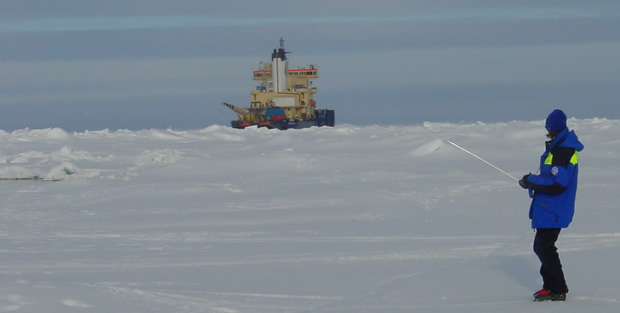
All groups are either setting up camp or sampling from Oden. The meteorologists are assembling 2 masts (15m and 30m tall), each with different meteorological or aerosol instruments. The physical oceanographers have drilled a hole inside their tent and are deploying a string of instruments down to 10 m under the ice. The aerosol and gas chemistry labs continue sampling from the ship round the clock with their automated systems. The helicopter has done a few science flights. Only the people who work on the ice are allowed off the ship; in our group that has been Paty, Andy, Carlton and Johan for now. Some of the scientists with automated systems on the ship would really like to get off the ice but no "touring" is allowed for the time being. You can see the ship next to the ice floe and the layout in the attached pictures.
The days run fast into each other....
The seal came back. We collected 80 liters of subsurface seawater to bring back to the ship to sample for various things. The cold wind makes working outside slow.
All groups are either setting up camp or sampling from Oden. The meteorologists are assembling 2 masts (15m and 30m tall), each with different meteorological or aerosol instruments. The physical oceanographers have drilled a hole inside their tent and are deploying a string of instruments down to 10 m under the ice. The aerosol and gas chemistry labs continue sampling from the ship round the clock with their automated systems. The helicopter has done a few science flights. Only the people who work on the ice are allowed off the ship; in our group that has been Paty, Andy, Carlton and Johan for now. Some of the scientists with automated systems on the ship would really like to get off the ice but no "touring" is allowed for the time being. You can see the ship next to the ice floe and the layout in the attached pictures.
The days run fast into each other....
Wednesday, August 13, 2008
August 13 2008
See the pictures I've put online at the following website:
http://picasaweb.google.com/pmatrai1/Arctic2008
http://picasaweb.google.com/pmatrai1/Arctic2008
Subscribe to:
Posts (Atom)